Most breakages on moving day come from the same few mistakes: plates packed flat, glasses wrapped together, mirrors laid flat under boxes, and TVs carried screen first. If you are wondering how to pack plates for moving, or how to pack a TV without its box, this guide covers each item step by step. It also matters more in Bradford than you might think. Boxes go down worn stone steps, round tight terrace staircases and over cobbled back streets before they reach the van, so good packing pays off.
Materials list
Get these together before you start. Running out halfway is how people end up using carrier bags.
- Small and medium double-wall boxes for kitchenware (large boxes get too heavy when full of plates).
- Dish pack or cell boxes with dividers for glasses, if you can get them.
- Plain packing paper (lots of it). Newspaper works but the ink rubs off on china.
- Bubble wrap for the most delicate pieces.
- Strong parcel tape and a tape gun.
- Moving blankets or old duvets for TVs, mirrors and furniture.
- Cardboard corner protectors and flat sheets of cardboard for mirrors and frames.
- Marker pens and “fragile” and “this way up” labels.
- Sealable bags for screws, cables and remotes.
Our guide to buying removal boxes or kits explains which sizes to buy and how many you need.
How to pack plates for moving
- Prepare the box. Tape the bottom with an H pattern (one strip along the seam and one across each end). Put a layer of scrunched paper in the base, about a hand’s depth.
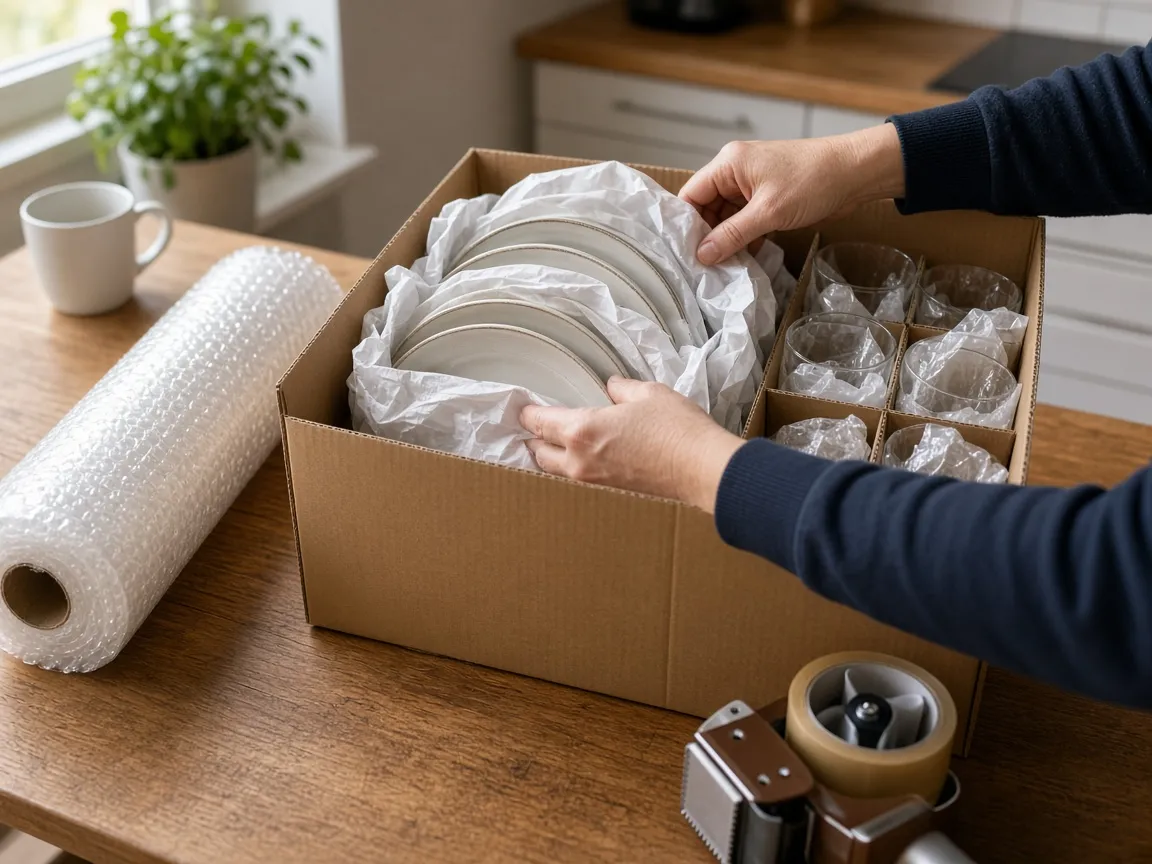
- Wrap each plate. Lay a plate in the middle of a few sheets of paper, fold a corner over, then the next corner, until it is covered. For good china, wrap in bubble wrap as well.
- Bundle in small stacks if you like. Some people wrap three or four plates together after each one is wrapped. Keep bundles small so they are not heavy.
- Stand plates on their edge. Load them upright in a row, like records in a crate. A plate on its edge is far stronger than one lying flat.
- Fill every gap. Push scrunched paper or tea towels between plates and around the sides. Nothing should move when you gently shake the box.
- Top layer and seal. Add more paper on top, close the box and tape it. Mark it “fragile”, “kitchen” and “this way up” on two sides.
Bowls go in the same way, nested in small stacks with paper between each one, standing on their rims or sides. Put the heaviest items at the bottom of the box and the lightest at the top.
How to pack glasses
- Use a box with cell dividers if possible. If not, line a small box well with paper.
- Stuff a little paper inside each glass first, then roll it in paper from one corner, folding in the ends.
- Wrap stemmed glasses with extra paper round the stem, the weakest point.
- Stand glasses upright, rim down or rim up, with no glass touching another.
- Keep glass boxes light and on top of heavier boxes in the van, never underneath.
How to pack mirrors and pictures
- Tape a large X across the glass with masking tape. It will not stop a crack but helps hold pieces together if one happens.
- Fit cardboard corner protectors.
- Wrap in bubble wrap or a moving blanket.
- Sandwich between two sheets of flat cardboard, or use a mirror box, and tape it closed.
- Mark “glass” and “do not lay flat”.
Carry mirrors and framed pictures upright, and load them upright in the van, tight against something firm. On narrow Bradford stairs, carry large mirrors with two people and plan the turn on the landing before you start.
How to pack a TV for moving
With the original box
This is the best option. Put the TV back in its foam inserts, seal the box, and keep it upright.
Without the original box
- Take photos of the cables at the back so you can reconnect them.
- Remove the stand or wall bracket fittings and put screws, cables and the remote in a labelled bag. Tape the bag to the back of the TV or keep it in your first night box.
- Cover the screen with a soft cloth, then wrap the whole TV in a thick moving blanket or duvet.
- Tape the blanket, not the TV. Never put tape on the screen.
- Keep the TV upright at all times. Do not lay a flat screen down, and never put anything on top of it.
A crew will load the TV upright against a solid item and strap it in place.
Lamps, lampshades and ornaments
Lamps
- Remove bulbs and wrap them separately.
- Take the shade off. Pack shades on their own, or nest small ones inside bigger ones with paper between. Do not crush them in with other things.
- Wrap the lamp base in paper and bubble wrap and stand it upright in a box with plenty of padding.
Ornaments and small breakables
- Wrap each piece in paper, then bubble wrap if it has thin parts, such as handles or spouts.
- Pack in small boxes with lots of filling. Heavier items at the bottom.
- Pack sentimental or valuable items in a box you carry yourself.
Simple rules that prevent most breakages
- Keep boxes light enough for one person to lift comfortably.
- Fill every gap. Movement causes breakage.
- Label fragile boxes on two sides, with “this way up”.
- Do not mix heavy items (books, tins) in the same box as glass.
- Tell the crew which boxes are fragile so they go on top in the van.
For more general advice, read our moving house tips from Bradford crews.
Let the crew pack the fragile items
Packing a full kitchen and a cabinet of glass takes longer than most people expect. If you would rather hand it over, our packing service can pack the fragile items, the whole house, or anything in between, using the right materials. You can still pack the easy rooms yourself.
To book packing with your move, get a free quote online or call 08000862860.
Planning a move in Bradford?
Get a free, no-obligation quote, or try the cost calculator for a rough idea first.