
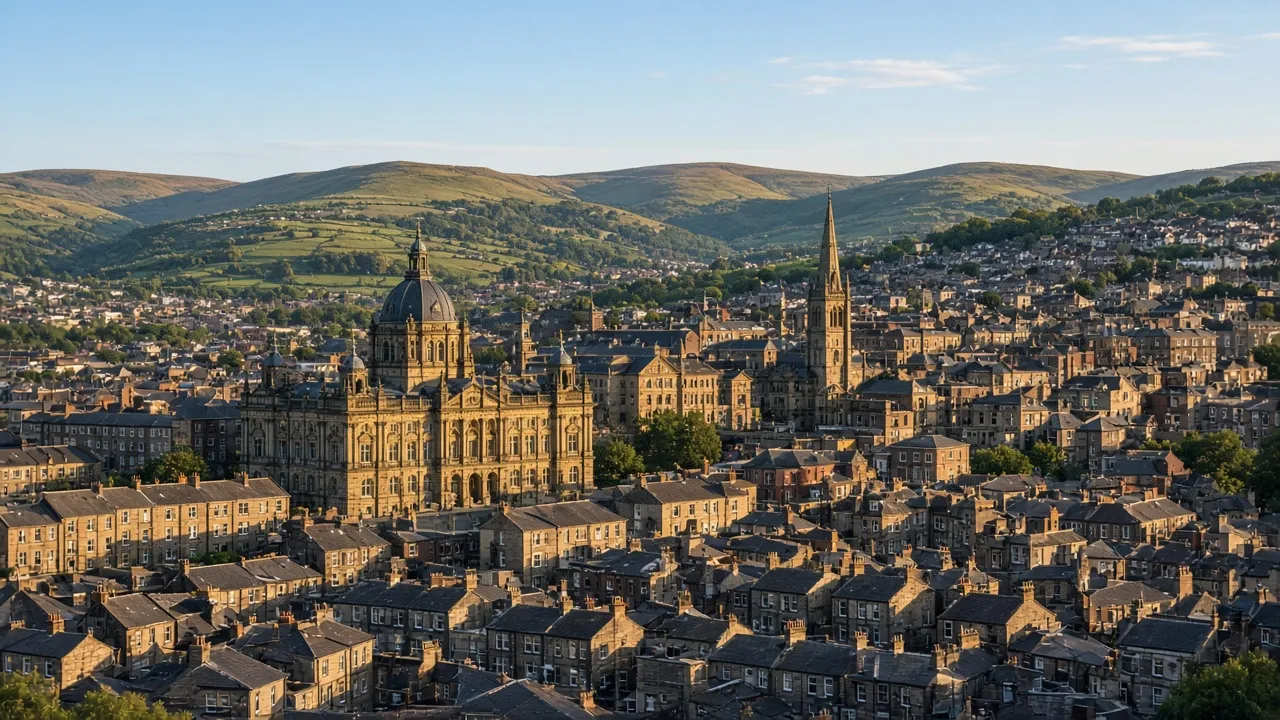
Bradford gets talked about a lot, and not always by people who have spent time here. This guide is for anyone thinking about living in Bradford: the good parts, the honest drawbacks, and the practical things you only learn once you have carried a sofa up a few of its streets. We are a local moving company based in BD9, and we spend our working days on the city’s terraces, hills and new estates, so we see a lot of it.
Is Bradford a good place to live?
For a lot of people, yes. The short version is this: Bradford offers more space for your money than many UK cities, quick access to open countryside, good rail and road links, and a culture all of its own.
The city grew rich on wool in the nineteenth century, and you can still see it everywhere. Grand stone mills, warehouses, chapels and long rows of terraced houses give Bradford a look unlike anywhere else in West Yorkshire. Many of those buildings now hold flats, offices, galleries and studios.
It is a young and diverse city, with communities from all over the world, and that shows in its food, festivals and shops. In 2025 Bradford was UK City of Culture, which brought a year of events and new attention to its venues and public spaces.
It is fair to mention the downsides too. Bradford is hilly, and some streets are properly steep. It sits on the edge of the Pennines, so the weather can be wet and the higher areas get colder in winter. Some neighbourhoods are busier than others, with more traffic and tighter parking, while others feel more like villages. The best way to decide is to visit a few areas at different times of day before you choose.
Neighbourhoods at a glance
Bradford is really a collection of districts and former villages, each with its own feel. Here is a quick tour. For a fuller comparison, read our guide on where to live in Bradford.
- Heaton: a popular residential area north-west of the centre, with Victorian stone houses, larger semis and leafy streets. Heaton Woods and Lister Park are close.
- Manningham: home to Lister Park, Cartwright Hall and Valley Parade, with grand Victorian villas alongside dense terraced streets and a lot of local shops.
- Frizinghall: a compact area between Manningham and Shipley with its own railway station on the line into Forster Square.
- Shipley: a town in its own right on the River Aire and the Leeds and Liverpool Canal, with a market, a station and quick links to Leeds.
- Saltaire: Sir Titus Salt’s model village, a UNESCO World Heritage Site with honey-coloured terraces, Salts Mill and Roberts Park.
- Idle: a hillside area with a village centre, stone cottages and good access to the airport road and Leeds.
- Eccleshill: a residential district in the north-east of the city with a mix of terraces, semis and newer homes.
- Allerton: a western suburb with semis, bungalows and quick access to open fields on the edge of the city.
- Thornton: a hilltop village on the western edge, best known as the birthplace of the Brontë sisters, with views over the valleys.
- Queensbury: one of the highest villages in the area, between Bradford and Halifax, with stone terraces and moorland views. Expect weather.
- Wibsey: a south Bradford district with a village feel, a central park and easy access to the M606.
- Bradford city centre: flats in converted mills and warehouses, especially in the Little Germany quarter, close to both stations, City Park and the university.
Housing and property types
Housing in Bradford is varied, and the type of home you choose will shape your move as much as your daily life.
Stone terraces and back-to-backs
The classic Bradford home is a stone terrace, often with a cellar, an attic room and stone steps up to the front door. Many streets also have back-to-back houses, where homes share a back wall and have just one entrance. They are full of character, but stairs tend to be narrow and turning, and parking on the street can be tight.
Victorian villas and larger houses
Heaton, Manningham and parts of Shipley have large Victorian houses, some split into flats. High ceilings and big rooms are the draw. Long stairs and stone steps are the trade-off.
Semis, bungalows and newer estates
Allerton, Thornton, Idle, Eccleshill, Queensbury and Wibsey have plenty of twentieth-century semis and bungalows, with gardens and driveways. New-build estates continue to appear on the edges of the city.
City centre flats
Converted mills and modern blocks in the centre suit people who want to walk to work or the station. Check lift access and loading arrangements before you move, especially for larger furniture.
Whatever you are moving into, our house removals crews know how to handle tight stairs, steep drives and narrow terraced streets.
Transport and getting around
Bradford is well connected for a city of its size.
Rail
The city has two main stations. Bradford Forster Square serves the Airedale and Wharfedale lines towards Shipley, Saltaire, Keighley, Skipton and Ilkley, plus trains to Leeds. Bradford Interchange has trains to Leeds, Halifax and across the Pennines to Manchester, and sits beside the main bus station. Smaller stations such as Frizinghall, Shipley and Saltaire make rail commuting easy from the north of the city.
Roads
The M606 runs from the south of the city to the M62 at junction 26, giving fast access east to Leeds and the A1(M), and west to Manchester. The A650 runs north through Shipley towards Bingley and Keighley, and the A647 links Bradford with Leeds. Rush hour on the main roads into the centre, such as Leeds Road, Manningham Lane and Thornton Road, can be slow.
Air and buses
Leeds Bradford Airport is a short drive north-east of the city, with flights to holiday and European destinations. Buses run from the Interchange to every part of the district and beyond.
Schools and universities
Bradford has a large number of primary and secondary schools, including academies and faith schools. Places are allocated through the council, and catchment rules matter, so check them before you choose a house. The school admissions pages on bradford.gov.uk explain how to apply and the key dates.
For further and higher education, the University of Bradford sits on the edge of the city centre and is known for subjects including health, engineering and management. Bradford College, on Great Horton Road, offers everything from vocational courses to degrees. Leeds, with its own universities, is only a short train ride away.
Culture and green spaces
Museums, galleries and theatres
The National Science and Media Museum in the city centre covers photography, film, television and science, and is free to enter. The Alhambra Theatre, with its distinctive domed roof, hosts touring musicals, drama and a famous annual pantomime. Cartwright Hall, in Lister Park, is the city’s main art gallery. Salts Mill in Saltaire holds a large collection of work by David Hockney, who was born in Bradford.
City Park, in front of City Hall, has one of the largest urban water features in the UK and is the setting for many of the city’s events. Bradford Cathedral is a short walk away.
Parks and countryside
Lister Park is one of the city’s best-loved parks, with a boating lake, Mughal-style water garden and Cartwright Hall at its centre. Peel Park, Bowling Park and Roberts Park in Saltaire are other favourites.
Saltaire itself, a UNESCO World Heritage Site, is a lovely place to walk along the canal and river. Beyond the city, Ilkley Moor is a short train ride from Forster Square, and the Yorkshire Dales and Brontë country around Haworth are close enough for a day out.
City of Culture 2025
Being UK City of Culture 2025 brought a year of music, theatre, art and community events, and a lot of new interest in Bradford’s venues. Much of that energy has carried on into the city’s events calendar.
Food and shopping
Food
Bradford has a long-standing reputation as a curry capital of Britain, and it is well earned. South Asian restaurants, sweet centres and takeaways line many main roads, with some of the best known clustered along Leeds Road, Great Horton Road and the streets around Manningham Lane and Oak Lane. Many have been family run for decades.
Beyond curry, you will find Middle Eastern grills, Eastern European bakeries, traditional chip shops, cafés in converted mills and a growing number of independent places in Saltaire and the city centre. Local markets and specialist grocers make it easy to buy spices, fresh produce and halal meat.
Shopping
The Broadway shopping centre in the city centre has the big high-street names and is the main shopping destination. The Kirkgate Centre nearby has more stores and the city market. Saltaire is the place for independent shops, galleries and bookshops, especially around Salts Mill. Shipley, Idle, Thornton and other district centres have their own high streets and supermarkets for everyday shopping.
Sport
Football fans head to Valley Parade, home of Bradford City AFC, on the edge of Manningham. Rugby league is played at Odsal Stadium, home of the Bradford Bulls, in the south of the city near Wibsey. Cricket has deep roots here too, and the historic Park Avenue cricket ground is part of the city’s sporting story. There are also golf courses, swimming pools and sports centres across the district, plus moors and trails for runners, walkers and cyclists.
Moving to Bradford
If this guide has you thinking seriously about a move, our post on the things you need to know when moving to Bradford covers the practical side, from council tax to settling in. Our team at Bradford removals works in every part of the city, with local and long-distance moves across the UK.
When you have a date in mind, get a free quote online or call 08000862860. Tell us about the stairs, steps and parking at both ends, and we will plan the rest.